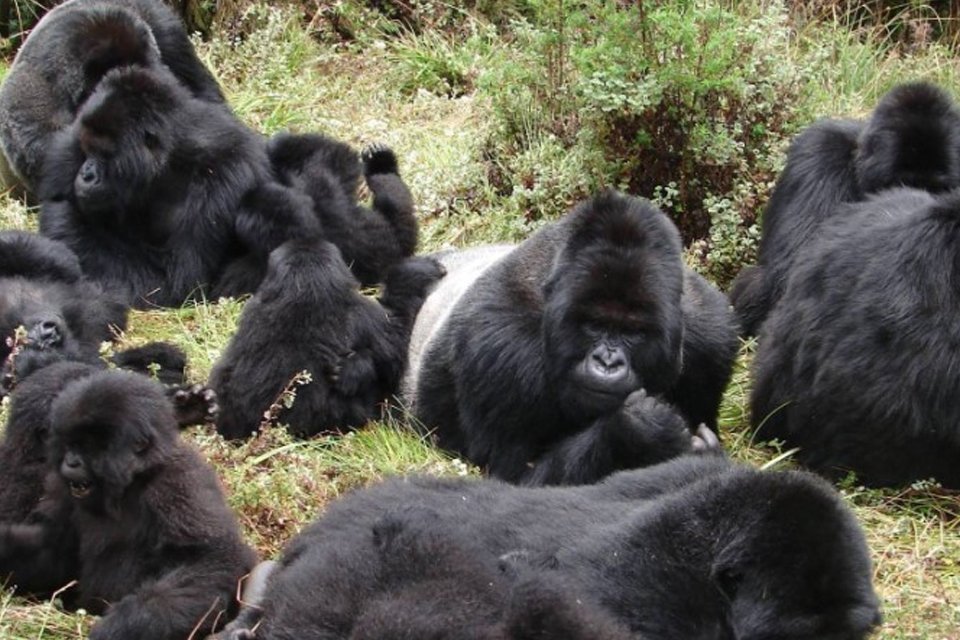
The Bikingi Gorilla Family is one of the most conservation-focused gorilla groups in Bwindi Impenetrable National Park.
Located in the Rushaga region of southern Bwindi, this family plays a unique role in gorilla trekking in Uganda.
Unlike fully habituated families visited daily by tourists, Bikingi is a semi-habituated, research-oriented group.
Its status highlights the scientific foundation behind sustainable gorilla trekking in Uganda.
Origins of the Bikingi Gorilla Family
The Bikingi family formed when a silverback separated from a larger group in southern Bwindi.
Over time, he attracted females and gradually established a new family unit.
This process required constant monitoring by trackers and researchers.
Rather than rushing the family into tourism, conservation teams prioritized controlled habituation.
This cautious approach reflects Uganda’s ethical philosophy toward gorilla trekking in Uganda.
Patience and science guide every stage of the process.
Semi-Habituation and Its Role in Gorilla Trekking in Uganda
Because the Bikingi family is semi-habituated, gorillas are less accustomed to daily human presence.
Their behavior remains more natural, alert, and occasionally unpredictable.
For researchers, this provides valuable data on gradual habituation responses.
For visitors, it adds depth to understanding gorilla trekking in Uganda.
Families like Bikingi demonstrate why access to gorillas is carefully regulated.
They reinforce the importance of long-term conservation over immediate tourism demand.
Habitat and Terrain of the Bikingi Family
The Bikingi family occupies remote areas of southern Bwindi’s rugged forest landscape.
This habitat features dense vegetation, bamboo zones, and steep terrain.
Trackers navigate challenging conditions daily to monitor the group.
These realities highlight the physical effort behind successful gorilla trekking in Uganda.
The remoteness also reduces disturbance during the habituation process.
Therefore, natural gorilla behavior is better preserved.
Behavior and Research Value
Bikingi gorillas typically maintain greater distance from humans than fully habituated groups.
They may move frequently and respond cautiously to human presence.
These behaviors are expected in semi-habituated families.
Researchers study these patterns to refine future habituation guidelines.
Such research directly improves ethical standards for gorilla trekking in Uganda.
Knowledge gained benefits both gorillas and future visitors.
Leadership and Family Development
Leadership within the Bikingi family continues to evolve.
The dominant silverback plays a central role in protection and group movement.
Tracking leadership stability helps conservation teams understand family growth.
These insights contribute to long-term success across gorilla trekking in Uganda.
Stable leadership often determines whether a family becomes tourism-ready.
Therefore, monitoring remains consistent and detailed.
Contribution to Sustainable Gorilla Trekking in Uganda
Although Bikingi is not a primary option for standard trekking permits, its role is crucial.
Research families expand the future pool of trekking-ready groups.
This reduces pressure on already habituated families.
As a result, gorilla trekking in Uganda remains sustainable and low-impact.
Limited visitor numbers per group protect gorilla wellbeing.
Research families support this balance behind the scenes.
Education and Visitor Awareness
Guides in the Rushaga sector often reference the Bikingi family during briefings.
Learning about semi-habituated groups enhances visitor understanding.
This context explains why strict trekking rules exist.
Therefore, gorilla trekking in Uganda becomes a conservation-driven experience.
Education transforms trekking into more than wildlife viewing.
It becomes participation in protection efforts.
Conservation, Communities, and Employment
Research-focused families like Bikingi create long-term conservation employment.
Local trackers, rangers, and researchers depend on these programs.
This strengthens community support for gorilla protection.
Consequently, gorilla trekking in Uganda supports livelihoods beyond tourism.
Community involvement reinforces conservation success.
It ensures shared responsibility for gorilla survival.
Conclusion: Bikingi’s Role in Gorilla Trekking in Uganda
In summary, the Bikingi Gorilla Family is a vital part of southern Bwindi’s conservation framework.
As a semi-habituated research group, it represents the future of gorilla trekking in Uganda.
Its existence protects natural behavior, guides ethical habituation, and supports sustainability.
Even without direct tourist access, Bikingi strengthens the foundation of Uganda’s gorilla tourism.
Ultimately, the Bikingi family proves that gorilla trekking in Uganda is built on science, patience, and long-term vision